
 Lorem ipsum dolor sit amet, consectetur adipiscing elit, sed do eiusmod tempor incididunt ut labore et dolore magna aliqua.
 Gravida dictum fusce ut placerat orci. In ornare quam viverra orci sagittis. Fermentum dui faucibus in ornare quam. Purus viverra accumsan in nisl nisi scelerisque eu ultrices. Non nisi est sit amet facilisis magna. Nunc consequat interdum varius sit amet. In ornare quam viverra orci sagittis eu. Id diam maecenas ultricies mi eget. Felis imperdiet proin fermentum leo vel orci porta non pulvinar. Praesent elementum facilisis leo vel fringilla est.
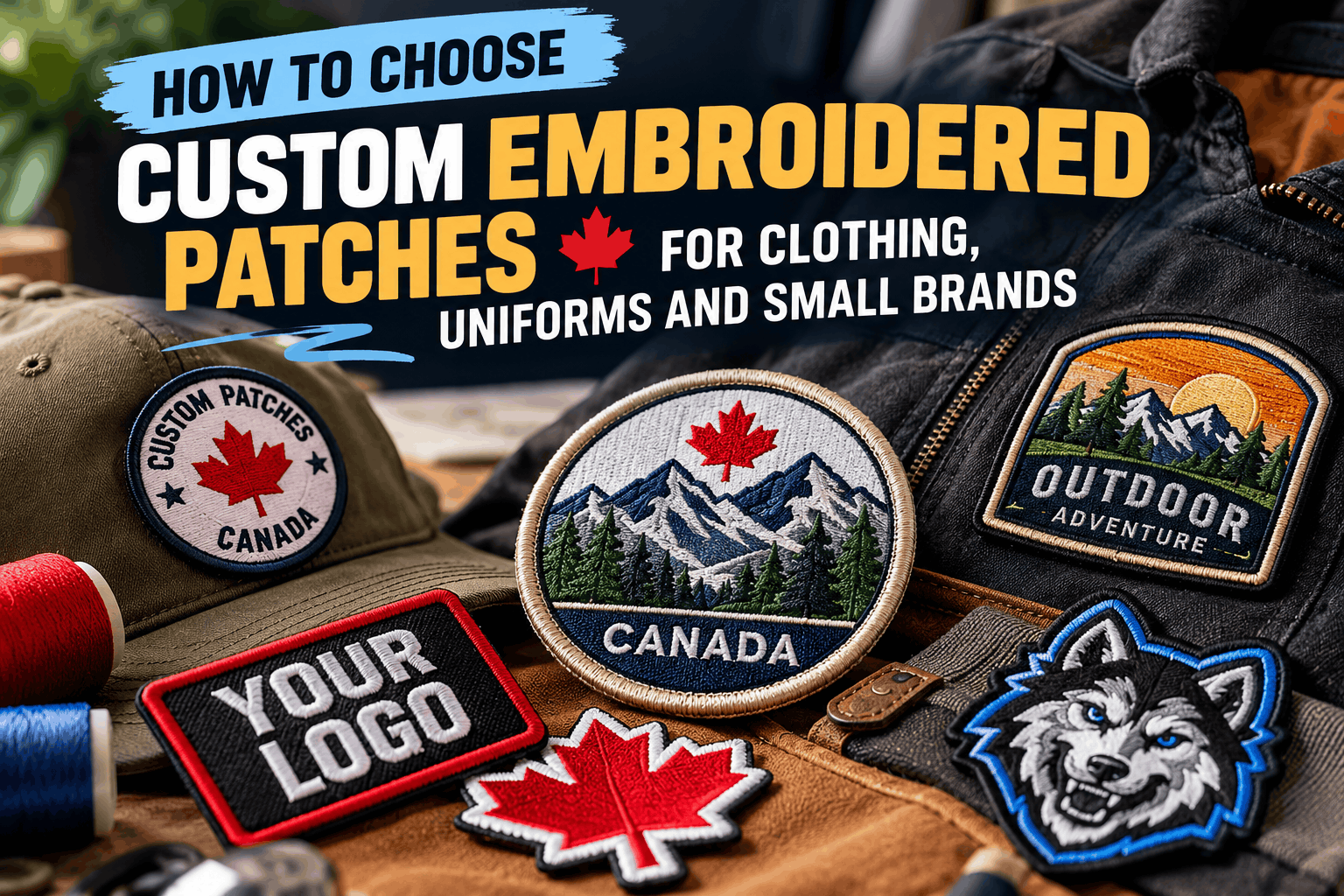
Custom embroidered patches are a practical way to add logos, names and distinctive designs to clothing. Businesses use them on uniforms, clothing brands add them to their products, and sports teams and clubs use them to create a consistent identity.
But ordering custom patches involves more than choosing a design and sending it to a supplier. The size, stitching detail, colours, backing and intended application all affect how the finished patch looks.
If you are planning your first order, or looking to improve the quality of patches you already use, here are the important factors to consider before production begins.
1. Start With the Artwork, Not the Patch Size
The artwork is one of the most important parts of a custom embroidered patch.
A logo that looks clear on a computer screen may need adjustments before it can be reproduced in thread. Small lettering, thin outlines, intricate shapes and tightly packed details can be difficult to reproduce clearly at a small size.
Before settling on a design, consider where the patch will be placed and how far away people will normally view it.
For example, a logo for a work jacket may need to remain readable from a few feet away. A decorative patch for a bag may allow more flexibility with detail, depending on its size.
Here are a few useful checks:
- Make sure important lettering is large enough to remain legible.
- Avoid unnecessary fine details that may become difficult to stitch.
- Use colours that provide sufficient contrast.
- Confirm that the design works at the actual patch dimensions.
- Ask for a production-ready proof before approving the order.
A good artwork review helps identify potential problems before production, when changes are generally easier to make.
2. Understand What Makes Embroidered Patches Different
Embroidered patches use stitched thread to create a raised, textured design. This gives them a traditional appearance that works particularly well for uniforms, jackets, club apparel, workwear and branded merchandise.
The stitching can add depth to a logo while making it feel more substantial than a simple printed graphic.
However, embroidery is not automatically the best choice for every design. Its suitability depends on the amount of detail, the size of the lettering, the desired finish and the overall appearance you want to achieve.
When comparing suppliers of custom embroidered patches in Canada, look beyond the product photographs. Consider whether the supplier explains its design process, provides artwork approval and helps customers understand the available customization options.
These details make it easier to decide whether an embroidered finish is right for your project.
3. Choose the Right Patch Size and Shape
The dimensions of a patch affect both its appearance and practicality.
A small patch can work well for a chest logo, sleeve detail or cap, while a larger patch may be more appropriate for the back of a jacket or a prominent club design.
Before ordering, measure the intended placement area rather than estimating the dimensions from a screen.
Think about these questions:
- Will the patch fit comfortably on the garment?
- Will the lettering remain readable at the selected size?
- Does the shape complement the logo?
- Will the patch look balanced when attached to the clothing?
- Is there enough room around the design for a suitable border?
Common options include circular, rectangular, shield-shaped and custom-cut patches. The best shape is usually the one that supports the design without adding unnecessary empty space or making the patch awkward to position.
4. Pay Attention to Thread Colours and Stitch Detail
Colour accuracy is especially important when patches represent a company, team or clothing brand.
A design might use specific brand colours that need to look consistent across uniforms, jackets and other merchandise. Although digital artwork is a useful reference, thread colours do not always appear identical to colours displayed on a monitor.
Ask how the supplier handles colour selection and artwork approval. Review the proposed design carefully and clarify any colours or details that are essential to your branding.
Stitch density and direction can also affect the finished appearance. Fine lettering, curved shapes and small symbols may require adjustments to make the artwork suitable for embroidery.
The aim is not to reproduce every tiny pixel of the original file. It is to create a patch that preserves the most important visual elements of the design.
5. Select a Backing That Suits the Garment
The backing determines how a patch is attached and can influence how practical it is for a particular application.
Sew-on backing
Sew-on patches are attached with stitching. They are useful for many jackets, bags, uniforms and other garments where a sewn attachment is preferred.
Iron-on backing
Iron-on patches have a heat-activated adhesive intended for application using suitable heat and pressure. Their compatibility depends on the fabric and the garment’s care instructions. Delicate materials and heat-sensitive fabrics may not be suitable.
Hook-and-loop backing
Often called Velcro-style backing, this option allows patches to be removed and reattached when used with a compatible surface. It can be useful for certain uniforms, tactical-style equipment and interchangeable identification patches.
There is no single backing option that works best for every customer. Consider the garment material, how often the patch may need to be removed and the conditions in which it will be used.
6. Know When Woven or PVC Patches May Be Better
Embroidered patches are popular for their stitched texture, but comparing materials before ordering can prevent disappointment.
Woven patches use finer threads to create a flatter surface, making them worth considering when a design contains small lettering or intricate detail.
PVC patches have a moulded, rubber-like appearance. They can be suitable for designs that benefit from a different texture or a more defined, dimensional finish.
Chenille patches, meanwhile, are often associated with varsity jackets and bold team lettering.
When researching custom patches in Canada, consider how different constructions suit your artwork and intended use instead of assuming that every design should be embroidered.
A supplier that explains the differences between patch types can help you make a more informed decision.
7. Check the Proof Before Approving Production
The artwork proof is your opportunity to review the proposed design before the order moves into production.
Do not approve it simply because the overall logo looks familiar. Check the details that matter.
Review the spelling, lettering, colours, proportions, border, dimensions and placement of important design elements. If the patch includes a small slogan or date, make sure it remains readable at the intended size.
If something does not look right, ask for clarification before approving the design.
It is also worth confirming the agreed quantity, backing type and product specifications at this stage. Keeping these details clear helps reduce misunderstandings later.
8. Consider Quantity, Pricing and Turnaround Together
The lowest quoted price is not necessarily the best value for a custom patch order.
When comparing suppliers, make sure you are comparing similar specifications. A quote for a small embroidered patch with one backing type may not be directly comparable to a larger patch with a different finish.
Check what is included in the price, whether artwork assistance is available, what quantity you need and whether shipping is included.
Turnaround time also matters, especially when patches are needed for an event, team season, uniform rollout or product launch.
Ask about the expected production and delivery timeline before placing the order. Allow extra time for artwork adjustments, approval and shipping rather than planning around an unconfirmed delivery date.
For larger orders, clarify the expected consistency between pieces and what happens if the delivered products do not match the agreed specifications.
9. Think About How the Patches Will Be Used
The best patch design depends on its real-world purpose.
For a small clothing brand, appearance and consistency across different products may be the priorities. A business ordering uniform patches may focus on logo readability and repeat-order consistency. A sports team may care more about its colours, team identity and how the patch looks on jackets.
Before ordering, consider the garment, the conditions in which it will be worn and the impression the finished patch needs to create.
It is also worth checking garment care instructions and following the supplier’s guidance on attachment and maintenance. No patch construction or backing is suitable for every fabric or use case.
Final Thoughts
Choosing custom embroidered patches in Canada becomes much easier when you understand the relationship between artwork, size, thread detail, backing and the garment itself.
Start with a clear design, choose dimensions that suit the intended placement and review the production proof carefully. Compare patch materials when embroidery may not be the best fit, and confirm the full order specifications before production begins.
Taking the time to check these details helps you make a better-informed decision and gives your finished patches a much better chance of matching your expectations.