48 Types of Necklines Explained With Pictures: V Neck, Round Neck & More
Have you ever admired a dress or a kurti and wondered what the shape around the neck is actually called? Maybe it has a neat round opening, a pointed V, a soft U-shaped curve or a neckline that sits almost on the shoulders. The name matters when you are shopping for sewing patterns, planning a custom outfit or choosing embroidery that will follow the fabric beautifully.
This illustrated guide walks through 48 different neckline types using clear explanations and original labeled drawings. You’ll learn what each neckline looks like, where you might find it, and how to decorate it without losing the character of the garment. It’s written for people who sew, design, customize kurtis and kameez, or simply want to know what they’re looking at.
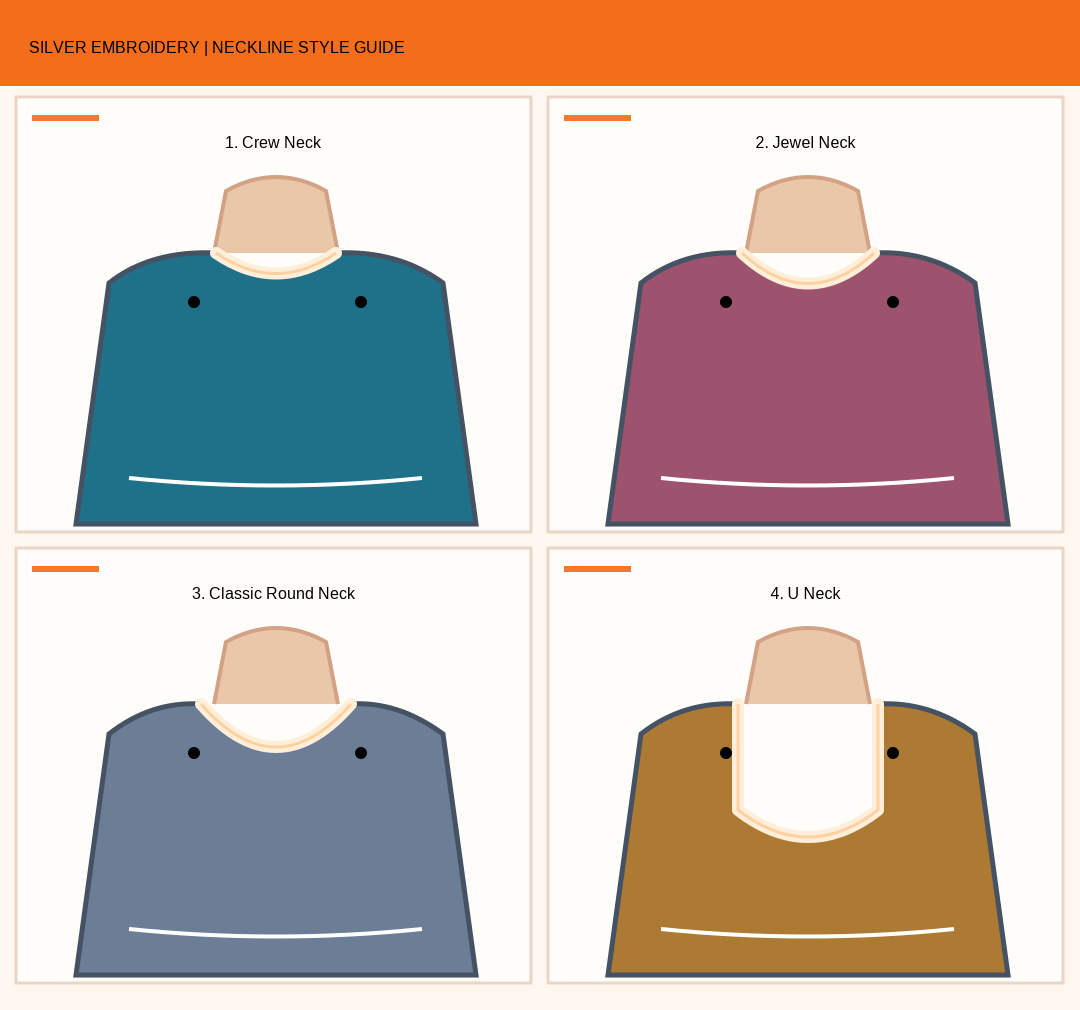
Quick distinction: A crew neck is a high round opening. A jewel neck is another close round style, generally a little lower. A U neck has longer sides; a scoop is often wider and deeper. A V neck has two edges that meet in a point, while a square neckline has a straight lower edge and defined corners.
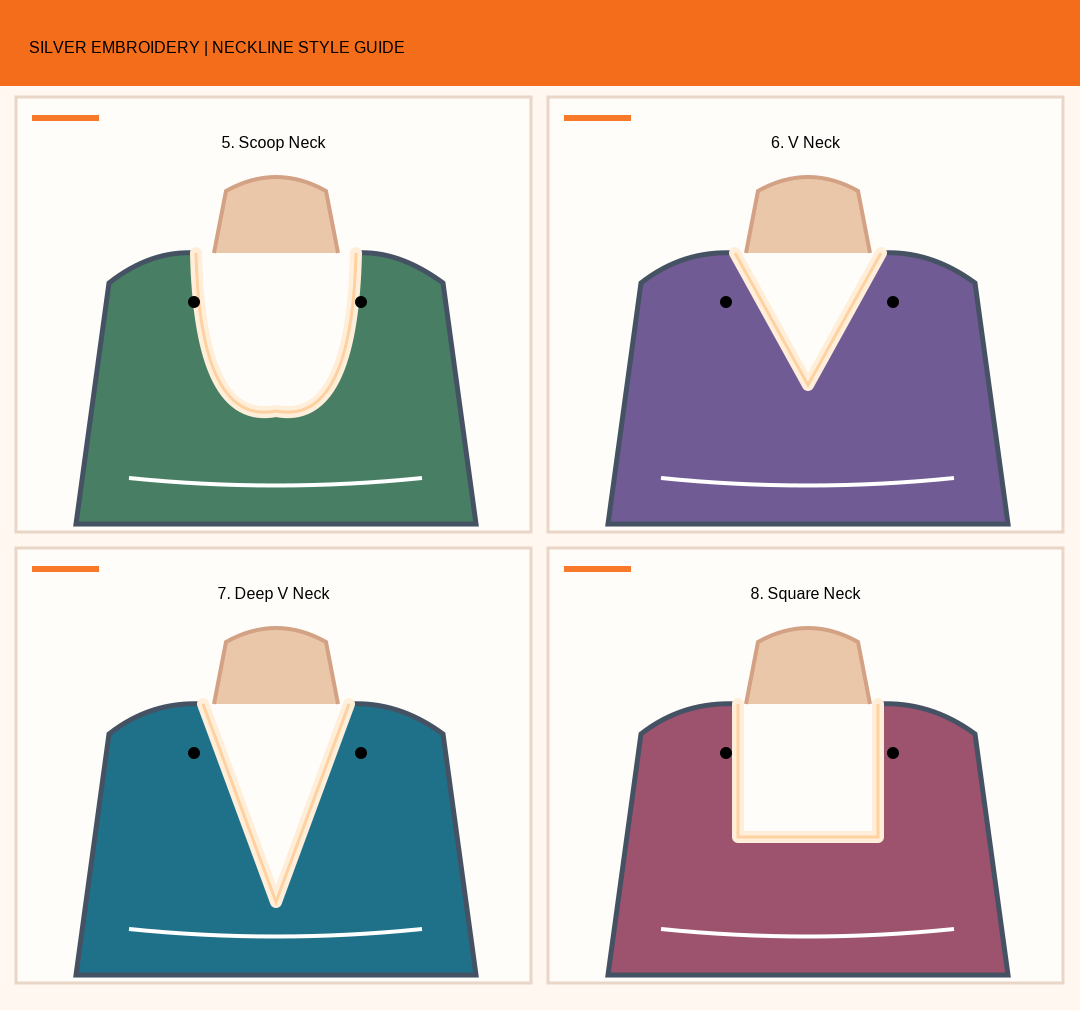
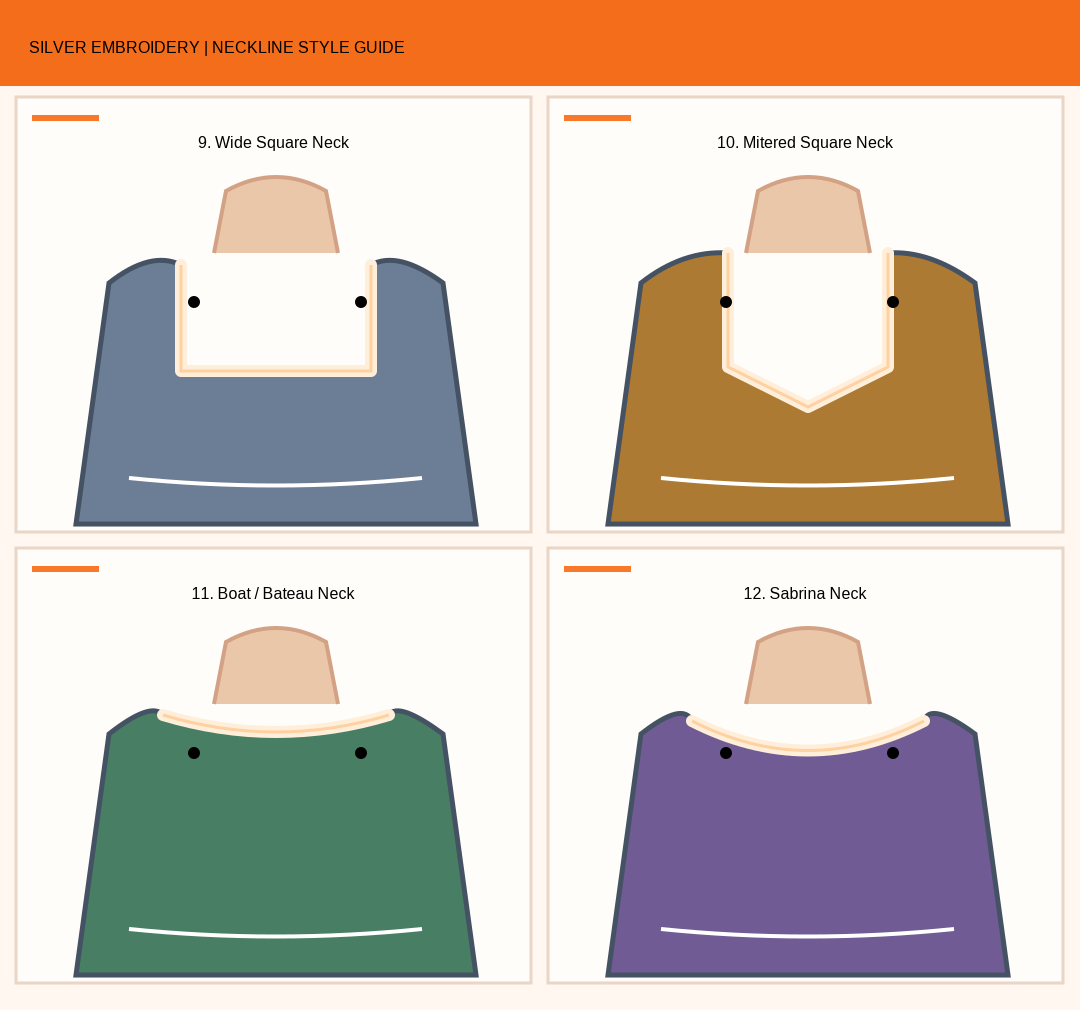
About the pictures: All 48 neckline shapes below are shown in 12 original schematic illustration charts made for this article. They are visual identification guides, not measured sewing or cutting patterns. Different designers may use some of the historic and variant names differently.
Browse Real Neck Embroidery Designs
Ready to stitch a neckline of your own? Explore our machine-embroidery collection to choose a pattern, check file formats and find a design for your outfit.
Neckline Types at a Glance
Start with the shape you can actually see: round, pointed, straight across, wrapped, raised, draped, asymmetric or held up by straps. If two names seem similar, the difference often lies in width, depth, shaping or garment construction.
Round and Everyday Necklines
1. Crew Neck
A crew neck is a high, rounded opening that sits close to the base of the neck. It is common on T-shirts, sweatshirts and simple knit tops, and it leaves very little upper chest exposed. Compared with a scoop neckline, the curve is tighter and shallower.
Embroidery idea: A narrow chain of daisies, tiny leaf motifs or a tone-on-tone stitched line works well. Keep dense embroidery away from a stretchy ribbed neckband.
2. Jewel Neck
The jewel neckline is also round, but it usually sits a little lower than a crew neck. It got its name from the area where a necklace naturally rests. You will see it on blouses, dresses and traditional tops when a neat, balanced opening is wanted.
Embroidery idea: Try a thin floral wreath following the finished edge, or two mirrored vines beginning near the shoulders.
3. Classic Round Neck
A round neckline is a broad name for an opening made with a smooth circular curve. The finished curve may be high and modest or slightly lower depending on the garment. This is one of the easiest shapes to decorate because the curve can carry a continuous border without a sharp corner.
Embroidery idea: For a kurti, place a slender embroidered border around the circle and finish it with a small central flower. Preview the design along the actual neck seam so the motif stays even.
4. U Neck
A U neckline has a rounded bottom and more noticeable vertical sides, making the opening look like the letter U. It can be shallow or deep, and it is popular on kurtis, kameez and summer blouses. Unlike a basic round neck, it often creates a longer vertical line in front.
Embroidery idea: Use long paired stems down both sides, with a flower or small paisley at the base of the U.
Open, Deep and Angular Neck Shapes
5. Scoop Neck
A scoop neck is a wide, generously curved opening that dips lower than most crew or jewel necks. The curve is soft and open, which makes this a popular choice for lightweight tops and casual dresses. A scoop and a U neck are related, but a scoop is often wider across the upper chest.
Embroidery idea: A spaced botanical border can trace the wide curve without overwhelming it. Leave sufficient room for comfortable movement.
6. V Neck
A V-neckline has two angled edges that meet in a point at the center front, forming the letter V. The point may sit high or low, and the opening can be narrow or wide. It is used in dresses, kurtis, tunics, cardigans and shirts because its clean diagonal lines give the garment a strong focal point.
Embroidery idea: Place matching embroidered leaf vines along the two sloping edges. A small blossom at the point of the V makes the design feel intentionally finished.
7. Deep V Neck
A deep V follows the same two angled sides as a standard V neck but carries the meeting point farther down the chest. You may see it on evening dresses, formal blouses and layered outfits. Because the opening is long, accurate symmetry and comfortable garment support become especially important.
Embroidery idea: Choose an elongated but narrow border. Test the complete design placement before stitching to keep both sides balanced.
8. Square Neck
A square neckline has a horizontal lower edge and straight sides, giving a rectangular or squared appearance. It is attractive on fitted dresses, blouses and traditional tops where clean lines matter. Unlike a round neck, the corners are part of the design and should look deliberate.
Embroidery idea: Small floral motifs in the corners or a simple geometric border complement the angular construction.
Wide Necklines and Square Variations
9. Wide Square Neck
This style keeps the straight lines of a square neckline but stretches the opening farther toward the shoulders. It creates an open, architectural frame and is common on sundresses and statement blouses. The horizontal edge deserves careful finishing so it stays flat.
Embroidery idea: Use compact corner flowers and a light chain of leaves across the horizontal edge.
10. Mitered Square Neck
A mitered square neckline emphasizes its angles with neatly joined corners. In sewing, mitering describes the way two finishing edges meet for a clean corner; it is more a construction detail than a completely separate silhouette.
Embroidery idea: Fine outlines and carefully aligned geometric units are more effective here than large rounded ornaments.
11. Boat or Bateau Neck
A boat neck is a broad, relatively shallow opening that runs from one side of the upper chest toward the other. It sits high near the collarbones and stretches outward toward the shoulders, creating a graceful almost-horizontal line. You will often see it on elegant tops and dresses.
Embroidery idea: Try small floral sprays near each shoulder instead of filling the entire span across the front.
12. Sabrina Neck
The Sabrina neckline is a wide, gently curved variation of the boat neck. It often follows a graceful line close to the shoulders, and it is familiar in bridal and formal clothing. The difference between a Sabrina and a boat neck can be subtle in real garment patterns.
Embroidery idea: A refined lace-effect or floral border near the shoulder edges can enhance the long, open line.
Romantic, Cutout and Decorative Necklines
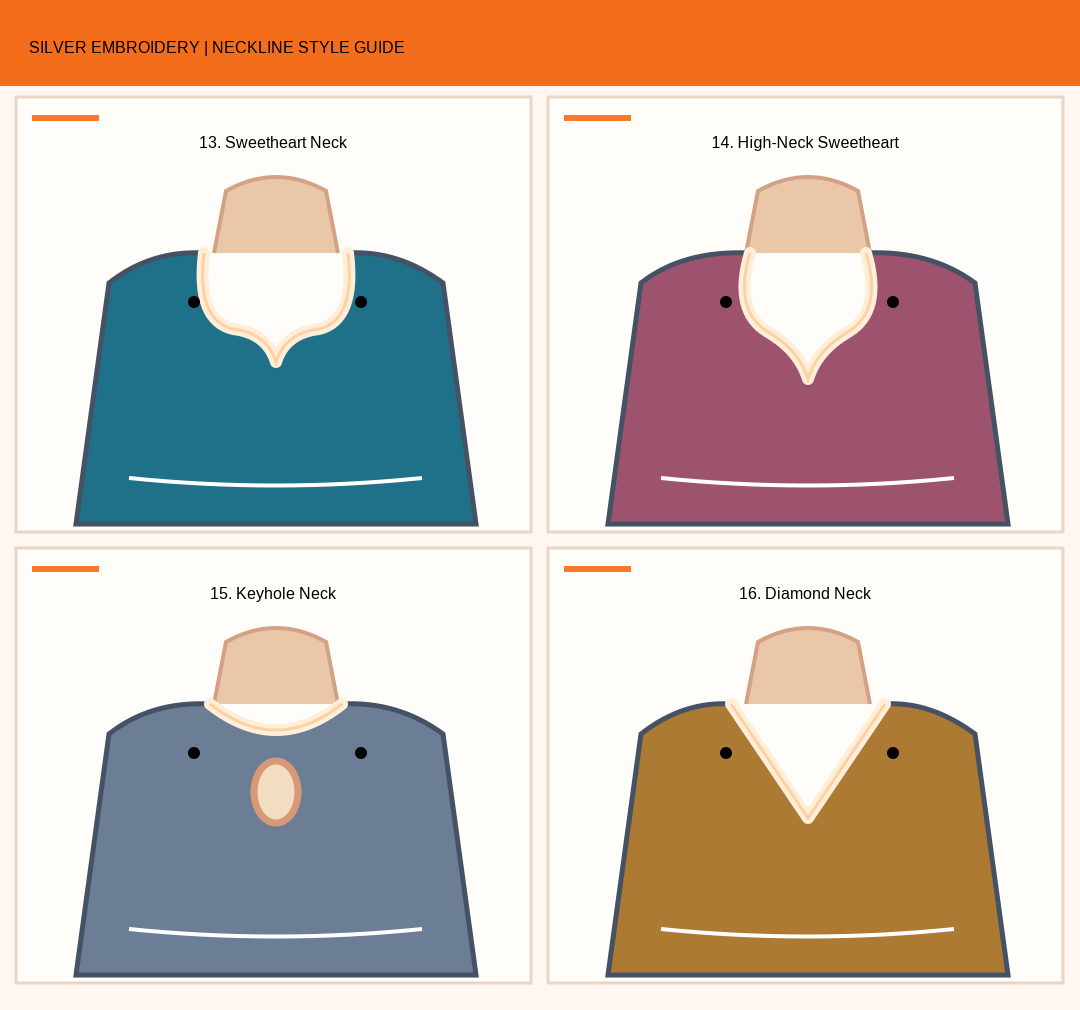
13. Sweetheart Neck
A sweetheart neckline curves into two rounded upper sections that meet in a dip at the center, resembling the upper outline of a heart. It appears frequently in dresses, blouses and occasionwear. The curves should be smooth and equal so the center looks intentional.
Embroidery idea: Choose delicate embroidery that follows each curve, then place a tiny flower or pearl-like stitch at the center dip.
14. High-Neck Sweetheart
This variation combines more coverage around the upper neck or shoulders with a sweetheart-shaped detail at the front. Depending on the pattern, the heart-shaped line may be created with a contrasting panel or shaped bodice section.
Embroidery idea: Use subtle thread shading along the heart-shaped seam without making the upper section too busy.
15. Keyhole Neck
A keyhole neckline has a small opening placed just below or within the neckline edge. That opening might be oval, round, teardrop or narrow and is often closed with a loop or button. It adds interest without requiring the entire neckline to be low.
Embroidery idea: Frame the opening with tiny flowers or an embroidered ring. Keep stitches clear of the fastening and button loop.
16. Diamond Neck
A diamond neckline uses a four-pointed or rhombus-shaped opening, sometimes as the main neck cut and sometimes as a front cutout. Its sharp angles feel graphic and modern, especially when the rest of the garment is simple.
Embroidery idea: Use narrow symmetrical motifs that point toward the diamond corners rather than crowding the opening.
Curved Edges, Slits and Wrapped Fronts
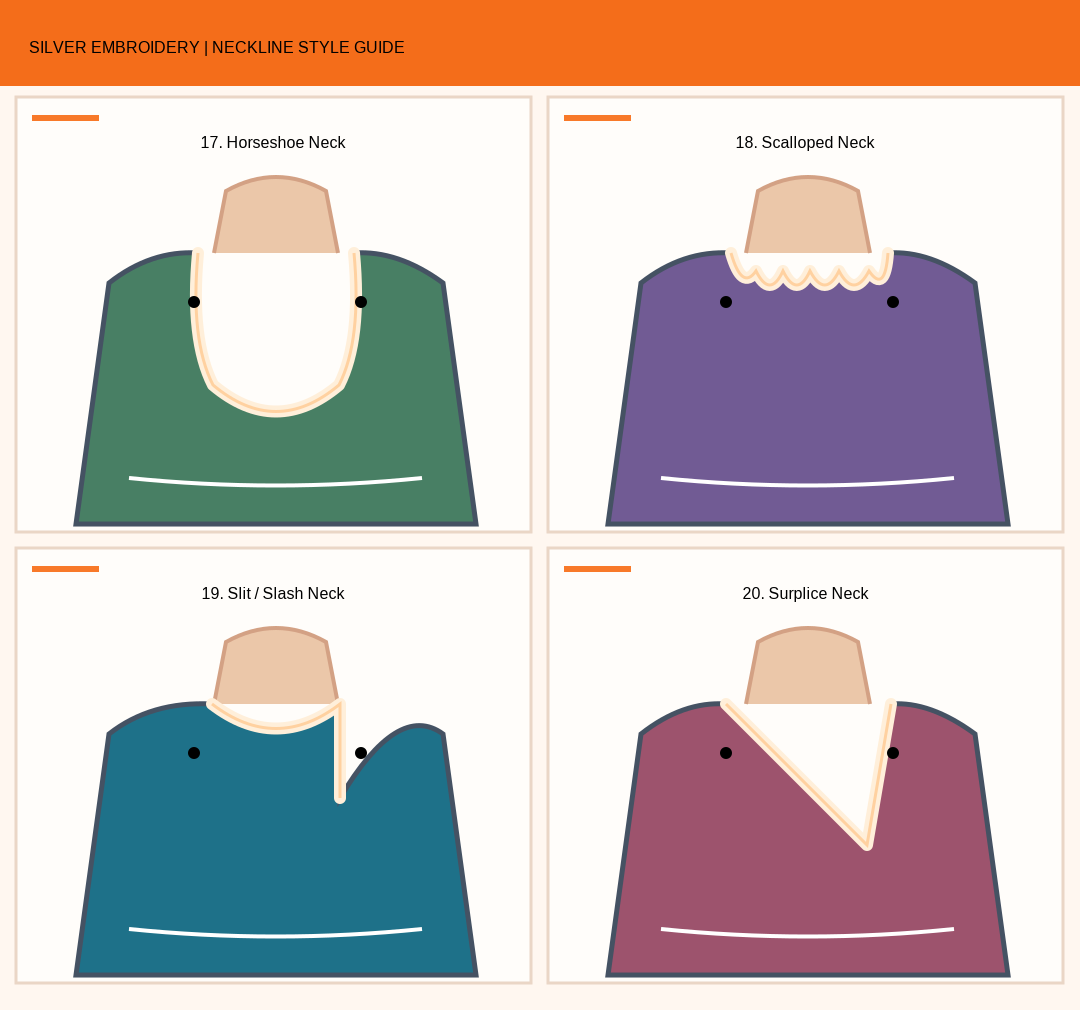
17. Horseshoe Neck
This neckline forms a rounded U-like curve with a fuller horseshoe shape. Depending on the pattern, it may sit close to the neck or extend into a wider opening. It is a useful alternative when a normal circle feels too plain.
Embroidery idea: An evenly spaced embroidered arc can emphasize the curve; avoid bulky stitches at the lowest point.
18. Scalloped Neck
A scalloped neckline has a series of small rounded waves along its finished edge. The scallops may face inward toward the neck or outward toward the bodice, and they create a decorative finish before any embroidery is added.
Embroidery idea: A light stitch outline following each scallop keeps the detail visible. Test the edge finish carefully before cutting.
19. Slit or Slash Neck
A slit neckline looks like a narrow cut or opening, often placed vertically at the center of an otherwise high neckline. It can be short and practical on a kurta or extended to form an attractive placket.
Embroidery idea: Two slim embroidered strips alongside the slit are a classic choice. Leave enough clearance for buttons or ties.
20. Surplice Neck
A surplice neckline is formed when one front section crosses over the other, usually creating a V-shaped opening. It is common on wrap tops and wrap dresses, where the overlap is a defining construction feature rather than just a decorative line.
Embroidery idea: Follow the visible crossover edge with fine embroidery, taking care not to interfere with how the layers lie.
Overlapping Fronts and Collar Finishes
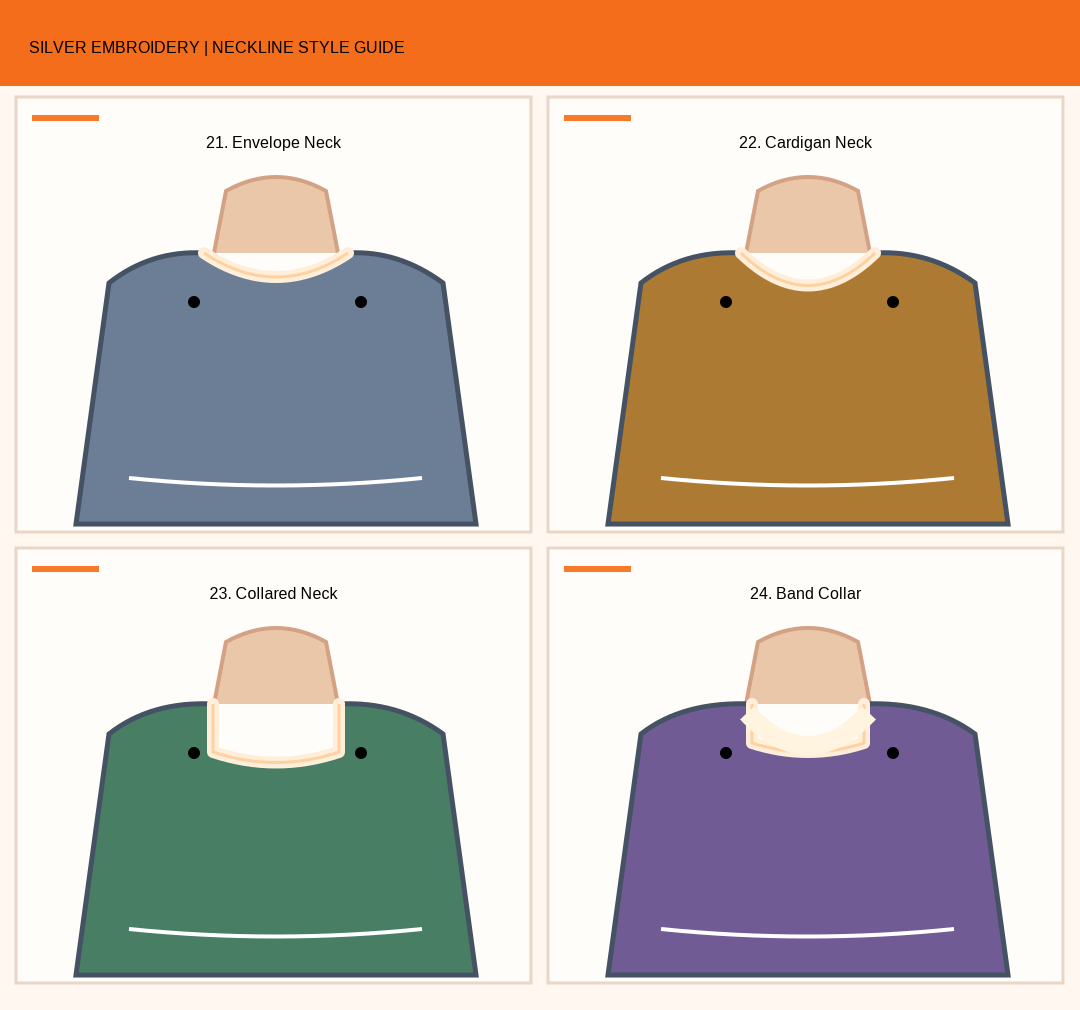
21. Envelope Neck
An envelope neckline is made with overlapping shoulder or neckline sections that stretch apart for easier dressing. It is especially common on baby bodysuits and soft infant tops. The overlap itself creates the shape.
Embroidery idea: Keep decoration tiny and soft. On infant clothing, avoid loose beads or rough raised stitching.
22. Cardigan Neck
A cardigan neckline typically has a front opening that continues down the garment, often with buttons, while the upper edge may be round or V-shaped. It is less about one fixed cutout and more about the front-opening construction.
Embroidery idea: A slim border along the opening or small motifs near the first buttons can add a custom finish.
23. Collared Neck
A collared neckline uses an attached fabric collar to frame the opening. Shirt collars, pointed collars and soft rounded collars each create a different look, and they may be paired with a button placket.
Embroidery idea: Embroider the collar tips, outer edge or tiny motifs above the button placket. Consider the underside and stiffness of the collar.
24. Band Collar
A band collar, sometimes called a stand collar, is a narrow upright strip of fabric around the neck without the usual folded collar points. It is widely used on kurtas and minimalist shirts.
Embroidery idea: Fine repeated leaves or a small geometric border can follow the band while leaving the neckline comfortable.
Raised, High and Gathered Necklines
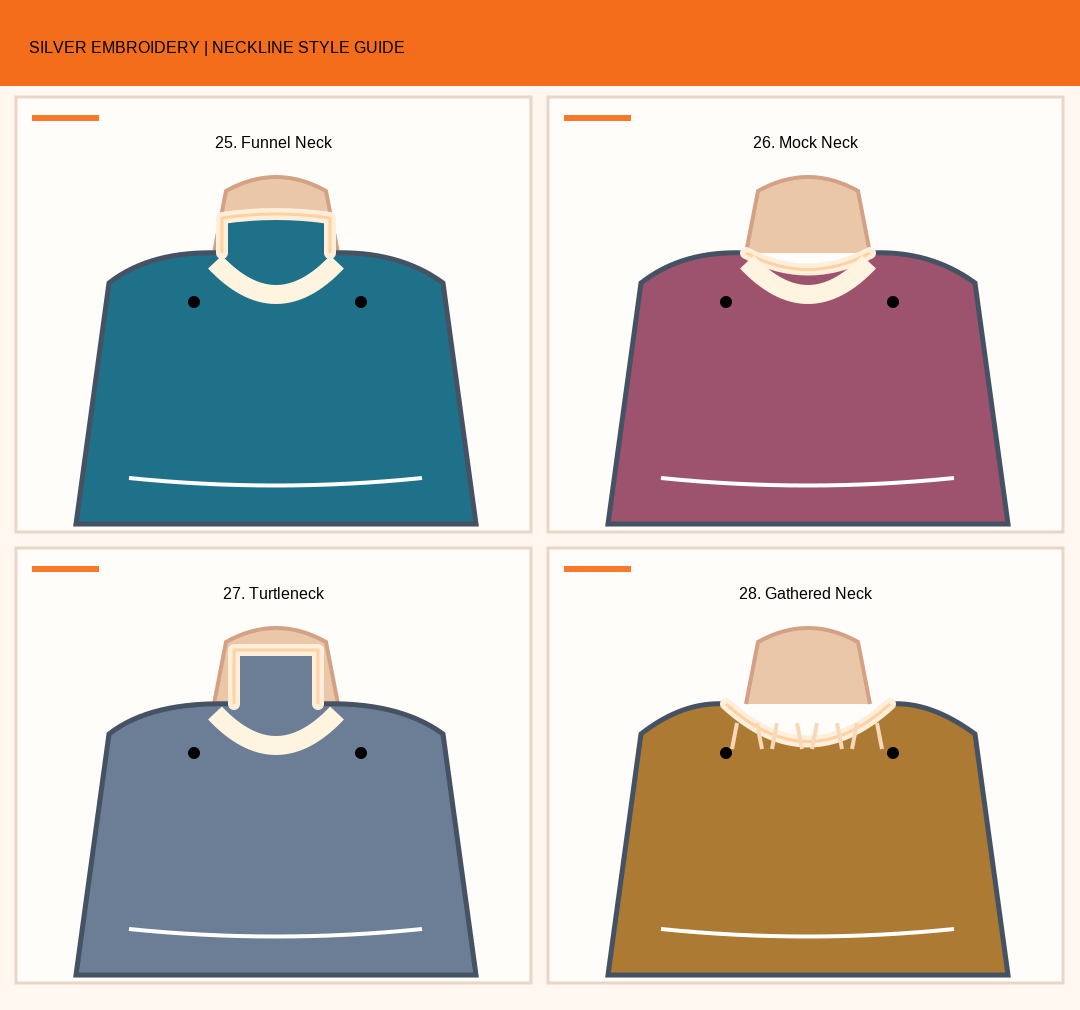
25. Funnel Neck
A funnel neck rises upward from the bodice in a soft, slightly flared shape. Unlike a close-fitting turtleneck, it often stands away from the neck and can be part of the garment’s own cut.
Embroidery idea: Place embroidery lower on the base of the funnel to avoid stiffening the raised section.
26. Mock Neck
A mock neck is a short raised collar that gives the impression of a turtleneck without folding over. It is often used on fitted tops, knits and contemporary dresses.
Embroidery idea: Use tiny, widely spaced motifs or a single fine line rather than dense stitching on stretch fabric.
27. Turtleneck
A turtleneck has a tall collar that usually folds back on itself to cover the neck. The collar is often made from knitted or stretchy material, so it should retain softness and flexibility.
Embroidery idea: If embroidering it at all, test low-density motifs on an appropriate stabilizer. Many garments look better with the embroidery below the collar.
28. Gathered Neck
A gathered neckline brings extra fabric into small folds near the neck, usually controlled by a binding, casing, seam or drawstring. The fullness gives the top a relaxed, soft shape and is common in peasant-style blouses.
Embroidery idea: Keep motifs below the gathering line, where fabric lies flatter, so the thread does not fight the folds.
Soft Drapes, Ruffles and Lace
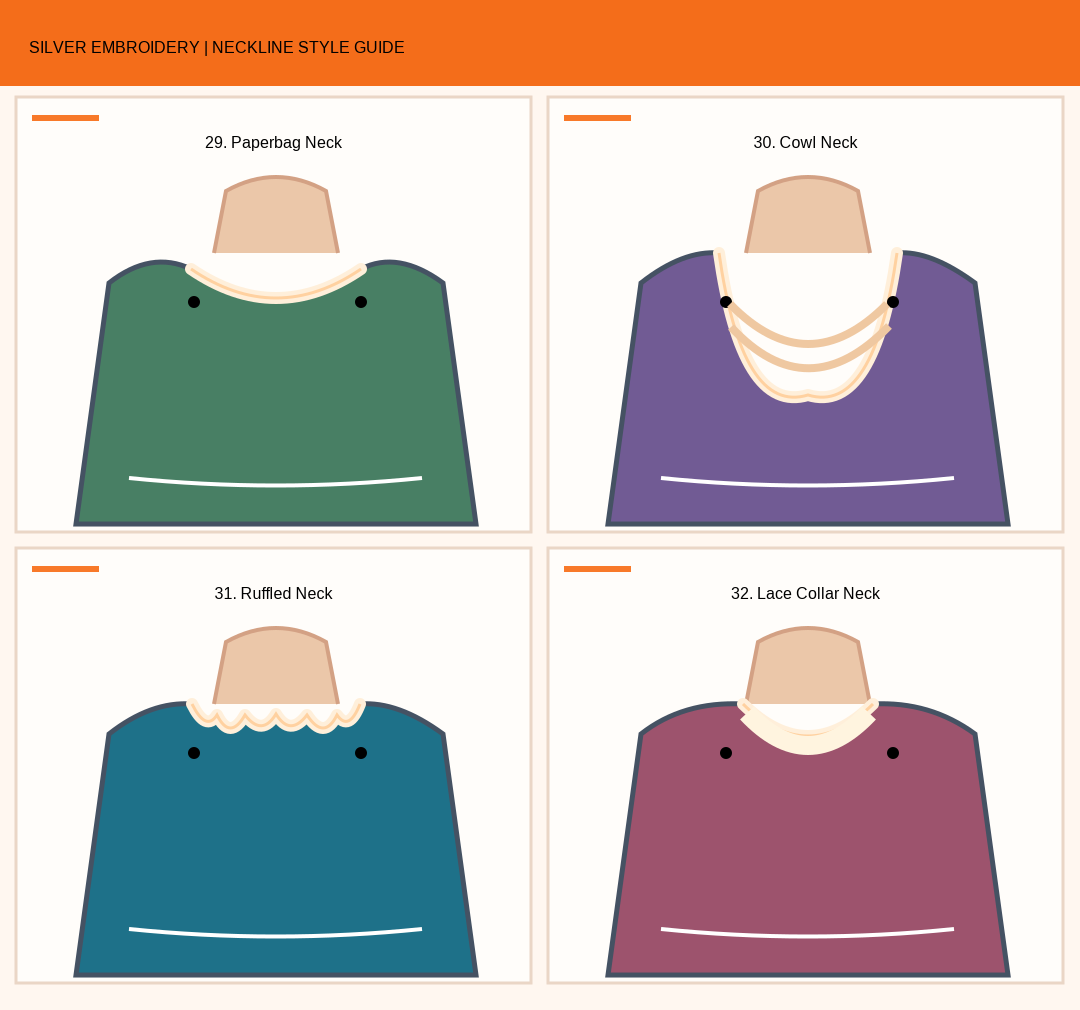
29. Paperbag Neck
A paperbag-style neckline uses gathered or cinched fabric that rises or softly frills above a seam or casing, creating a loose ruffled edge. It adds volume and texture around the upper bodice.
Embroidery idea: Small stitched accents below the gathered band work better than a heavy motif directly on the frill.
30. Cowl Neck
A cowl neck uses extra fabric to drape in soft folds around the front of the neck and upper chest. Rather than following one fixed outline, its look comes from the movement of the fabric itself.
Embroidery idea: Choose lightweight embroidery on a flatter area beneath the drape. Heavy stitches can change the way a cowl falls.
31. Ruffled Neck
A ruffled neckline features a decorative frill attached along the opening or formed with gathering. The ruffle may be tiny and neat or wide and romantic, depending on the fabric and garment.
Embroidery idea: A fine stitched line near the outer ruffle edge adds contrast while keeping the fabric soft.
32. Lace Collar Neck
This style adds a separate lace collar or lace edging around a neckline. The lace is the important design element, and the underlying opening can be round, V-shaped or another silhouette.
Embroidery idea: Use embroidery sparingly around the lace attachment so it complements, rather than competes with, the delicate trim.
Shoulder-Revealing Neckline Styles
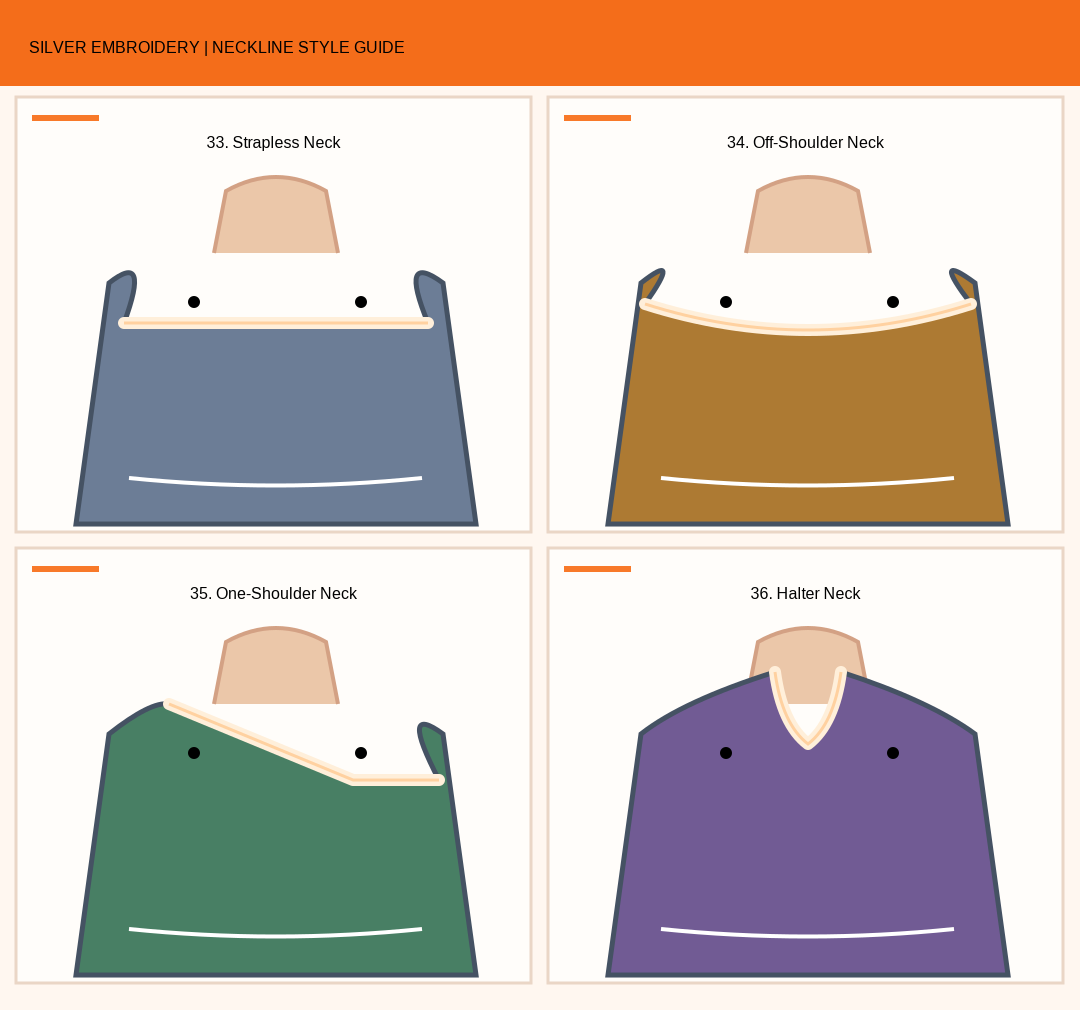
33. Strapless Neck
A strapless neckline leaves the shoulders and arms uncovered, with the garment held in place by the fit and support of the bodice. The top edge may be straight, curved or sweetheart-shaped.
Embroidery idea: A compact embroidered border along the top edge can create an elegant finish, but avoid thick stitching that makes the edge rigid.
34. Off-Shoulder Neck
An off-shoulder neckline sits below the shoulders and exposes the collarbones. Some designs have a continuous fold-over band, while others use elastic or structured bodice pieces.
Embroidery idea: Wide floral embroidery along the upper band can look beautiful, provided the garment still stretches or sits as intended.
35. One-Shoulder Neck
A one-shoulder neckline is asymmetric: one shoulder is covered by a strap or fabric while the other remains open. It gives a dress or blouse a distinctive diagonal line.
Embroidery idea: Place the main embroidered accent along the covered shoulder or upper diagonal, not across the entire bodice.
36. Halter Neck
A halter neckline is supported by fabric or straps that meet around the back of the neck, leaving much of the shoulder area exposed. The front opening may be high or shaped into a V.
Embroidery idea: A small vertical embroidered motif can emphasize the front center without weighing down the neck tie.
Straps, Plunges and Asymmetry
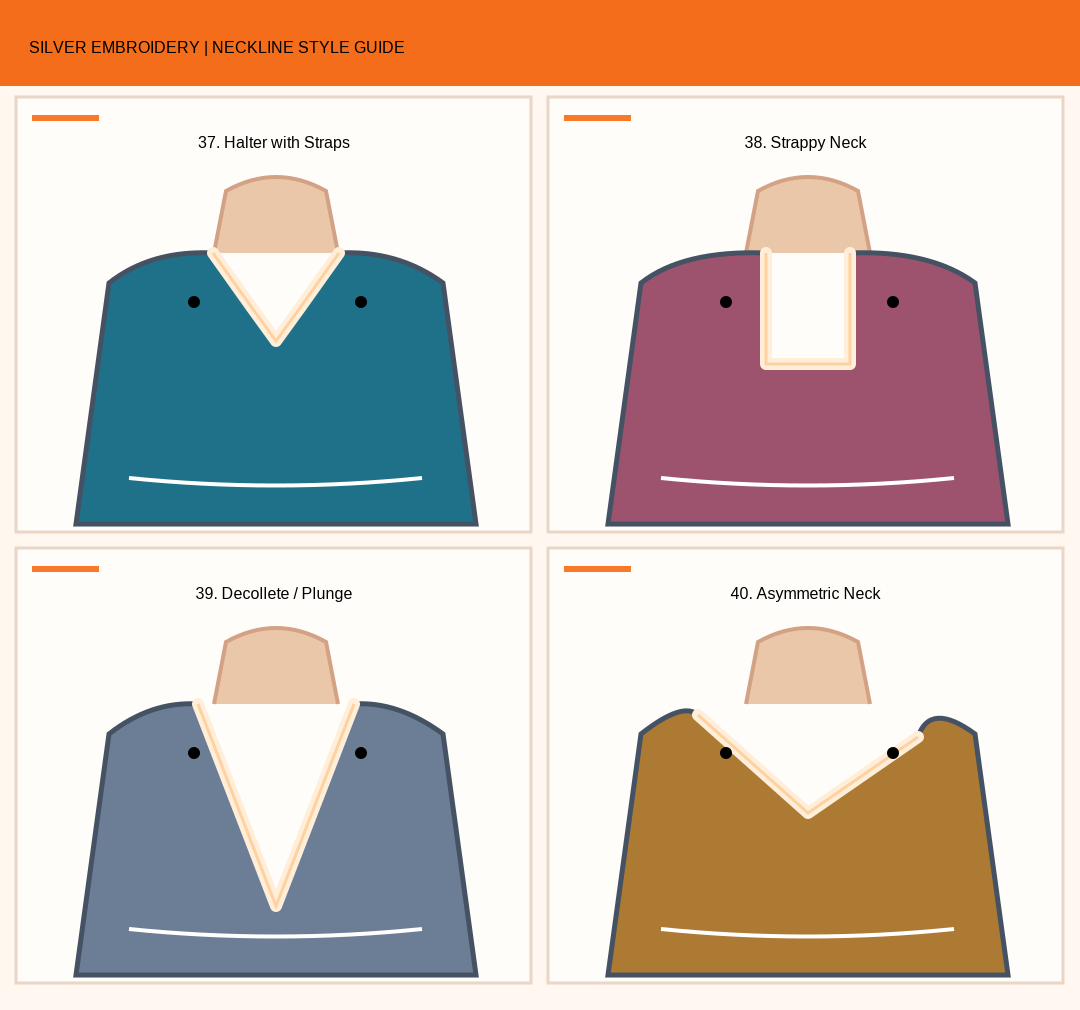
37. Halter with Straps
This hybrid neckline combines the close-to-the-neck support of a halter with extra shoulder straps or strap details. The combination can create interesting layered lines.
Embroidery idea: Use tiny motifs near attachment points rather than heavy decorations that distort the straps.
38. Strappy Neck
A strappy neckline uses narrow fabric straps to frame the upper chest and shoulders. The straps might run straight, cross over, or form several decorative lines.
Embroidery idea: Keep embroidery on the bodice below the straps, or add only very fine stitching on straps that can support it.
39. Decollete or Plunging Neck
Decollete describes an opening that reveals more of the neck and upper chest. A plunging neckline often has a particularly deep V, but the exact depth varies by garment and preference.
Embroidery idea: Slim border embroidery can underline the long opening while maintaining a neat, lightweight edge.
40. Asymmetric Neck
An asymmetric neckline deliberately uses different shapes or levels on the left and right sides. It may slope diagonally, combine a shoulder strap with a cutout, or have a distinctive irregular edge.
Embroidery idea: Instead of forcing mirrored motifs, let embroidery follow the garment’s unique line.
Historical and Illusion Necklines
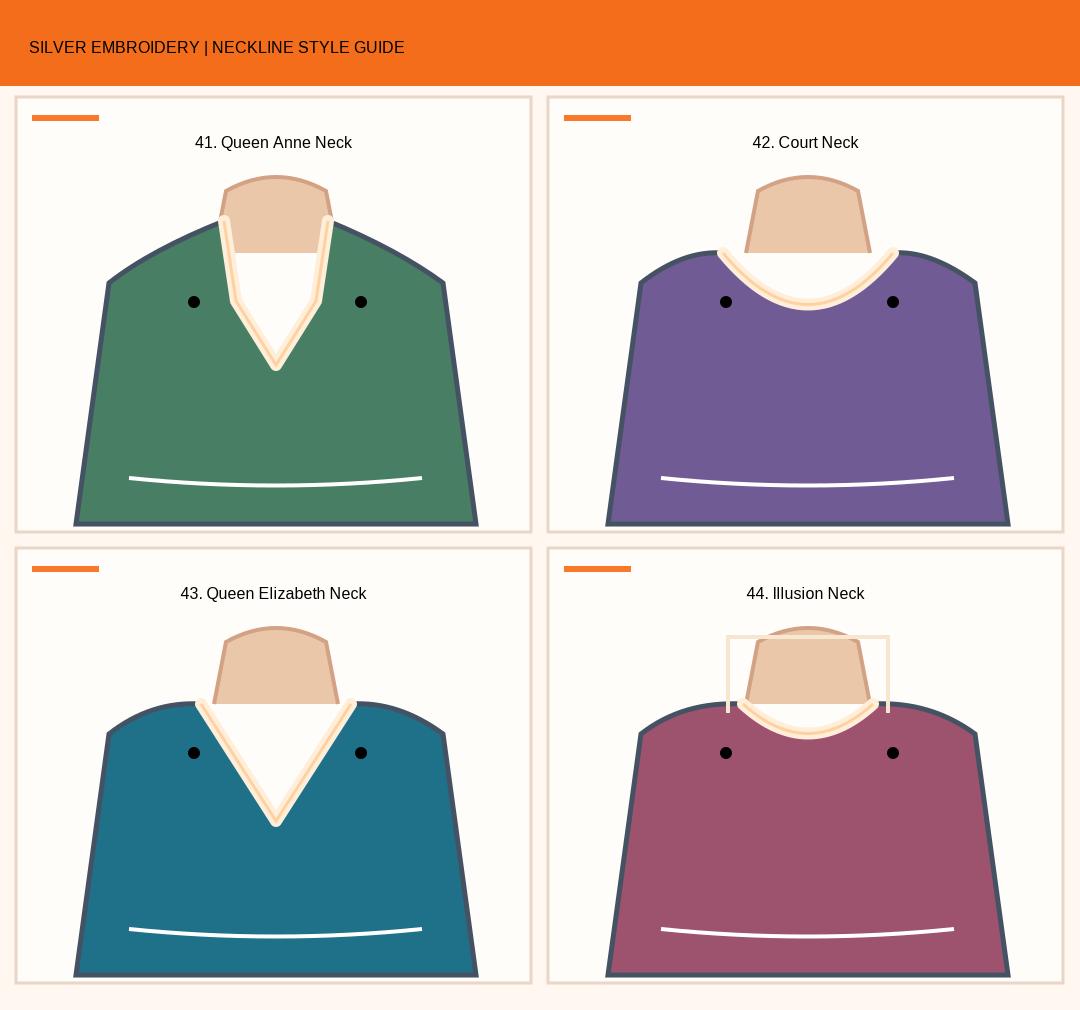
41. Queen Anne Neck
The Queen Anne neckline is generally recognized by a higher raised area at the back or sides and a shaped front, commonly a V or sweetheart arrangement. It appears in formal and bridal styles.
Embroidery idea: A fine embroidered border around the shaped front can bring attention to the construction without adding bulk.
42. Court Neck
Court neckline is a historical or formalwear term, and its exact interpretation can differ between costume references and commercial patterns. It typically suggests an elegant, shaped opening in formal dress.
Embroidery idea: Before digitizing embroidery for a specific pattern, use the designer’s actual neckline outline rather than relying on the historical name alone.
43. Queen Elizabeth Neck
Queen Elizabeth is another historical style label whose shape is not standardized across every fashion glossary. It is often associated with structured, decorative necklines inspired by period clothing.
Embroidery idea: For an elaborate historical-inspired outfit, consider a narrow ornamental border that respects the collar and neckline construction.
44. Illusion Neck
An illusion neckline uses a sheer or fine mesh section above or around a lower bodice neckline. The transparent layer provides a covered appearance while allowing the underlying neck shape to remain visible.
Embroidery idea: Embroidered flowers scattered over the mesh can look especially delicate, but support and stitching must suit the sheer fabric.
Yokes, Bibs, Bands and Back Details
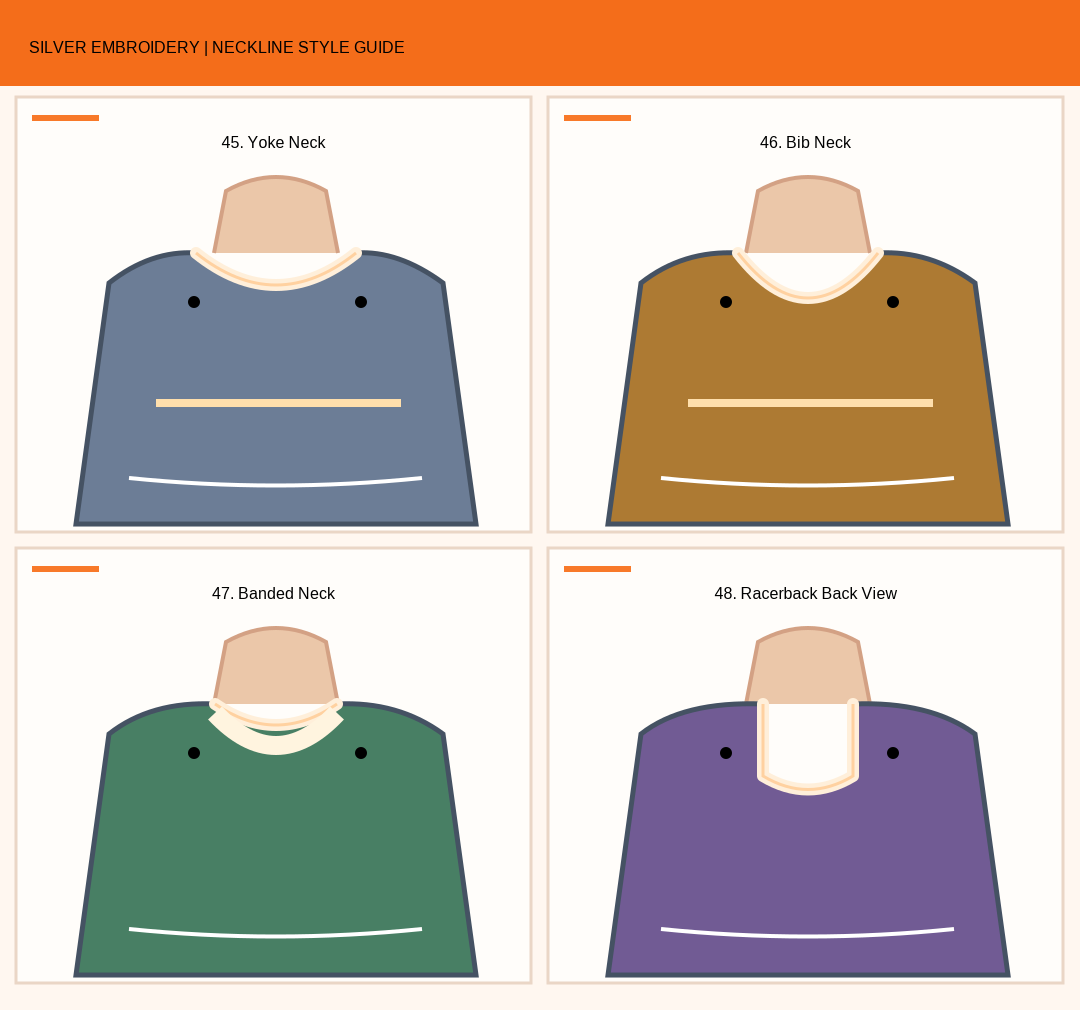
45. Yoke Neck
A yoke neckline includes a separate upper section of fabric around the neck and shoulders, joined to the garment below. The yoke seam may be straight, curved or decorative.
Embroidery idea: A line of embroidery along the yoke seam or a small all-over motif on the yoke gives this construction a clear purpose.
46. Bib Neck
A bib neckline has a distinct center-front insert or panel below the neck. The bib panel may be rounded or straight-edged and is a natural place for concentrated decorative details.
Embroidery idea: Place a balanced floral or geometric embroidery pattern inside the bib so the surrounding fabric stays calm.
47. Banded Neck
A banded neckline is finished with a separate strip of fabric that frames the neck opening. It may be used on round, V or other shapes and is a practical way to make an edge look neat.
Embroidery idea: An embroidered line just outside the band creates a polished accent without interfering with the finish.
48. Racerback Neck
Racerback describes a back-of-garment shape where shoulder straps angle inward toward the center, often making a T or Y outline. It is common on sports and casual tops and is best understood from a back view.
Embroidery idea: If decorating the back, choose lightweight stitching around the central panel while allowing the straps to move comfortably.
How to Choose the Right Neckline for Your Outfit
Start with the garment’s job. A daily-wear cotton kurti may benefit from a simple round, U or slit neckline; a party dress might use a sweetheart, boat or one-shoulder style. It helps to think about comfort, layering, jewelry, neckline finishing and how easily the garment goes on and off.
Match embroidery to the line
Round necklines suit continuous arcs of small flowers. A V or surplice neckline can carry two mirrored vines toward the central point. Square necklines are good for tiny corner motifs, while a boat neckline often looks balanced with floral details near each shoulder. On gathered, cowl and ruffled necklines, embroider a flatter part of the garment so the fabric can still drape freely.
Check the size before digitizing
Take the neckline measurements from the garment or actual pattern. Find the center front, note the depth and width, and mark seams or closures. An embroidery preview should fit those measurements rather than simply being enlarged or reduced to fill the available space.
Consider the fabric and stabilizer
Lawn, cotton, linen, satin, mesh and knits behave differently. A dense stitched border can distort a lightweight fabric; a stretch material needs careful handling, and sheer fabric demands discreet support. Always stitch a sample using a comparable material and the stabilizer appropriate to your design.
Round Neck vs V Neck vs U Neck vs Scoop Neck
| Neckline | Recognizable shape | Embroidery approach |
|---|---|---|
| Round | Soft circular opening | Small floral arc |
| V Neck | Two angled edges meet at a point | Mirrored vines along each side |
| U Neck | Rounded bottom with longer sides | Long, slender border and bottom accent |
| Scoop | Open, wide, deep curve | Spaced botanical trim |
| Square | Straight lower edge and corners | Corner flowers or geometric lines |
| Boat | Wide, shallow line close to shoulders | Subtle motifs toward the shoulders |
Frequently Asked Questions About Necklines
What is a V-neckline?
It is a neckline made from two sloping edges that meet in a point at the front. The V can be narrow, wide, shallow or deep. For embroidered kurtis, matching vines along its two sides are a natural choice.
Is a round neck the same as a crew neck?
Not exactly. Round neck is the broader description. Crew neck usually refers to a higher, close round cut, often finished with a ribbed band on T-shirts.
What is the difference between a U neck and a scoop neck?
Both are softly rounded, and the terms overlap. A U neckline usually has more clearly extended vertical sides; a scoop generally feels broader and more open across the chest.
Which neckline is easiest to add embroidery to?
A simple round, U, V or square neckline often gives a clear sewing and stitching path. The best option also depends on fabric, construction and your chosen motif.
Are these pictures actual embroidery designs ready to download?
No. The pictures are original educational diagrams explaining neckline shapes. For actual machine-embroidery downloads, browse our Neck Embroidery Design Collection and check each product’s file formats and dimensions.
Explore More Neck Embroidery Ideas
Now that you can recognize different neck shapes, choosing a motif becomes much easier. For decorative patterns, color combinations and 100 practical ideas for kurtis, kameez and dresses, read our 100 Stylish Neck Embroidery Designs & Patterns. If you are ready to stitch, visit the Neck Embroidery Patterns Collection.
1 thought on “48 Types of Necklines Explained With Pictures: V Neck, Round Neck & More”